

WHY YOU CAN'T TURN OFF AFTER YOUR SHIFT -- AND WHAT TO DO ABOUT IT
Last updated: June 2026 | Reviewed by Ryanne Stellingwerf, MS, LCPC
You're good at your job. You show up, you handle it, and you do it well. But somewhere between the end of your shift and your own front door, something doesn't switch off the way it should. You're home but you're not really there. You're exhausted but you can't settle. You love the people around you and you keep snapping at them anyway.
This guide is for female first responders, military women, and veterans who are still performing at work and quietly falling apart everywhere else. By the time you finish reading, you'll understand exactly what's happening in your nervous system, why it doesn't just fix itself, and what actually changes it -- without costing you the edge that makes you good at what you do.
I spent 7 years in Iraq and Afghanistan before I became a therapist. I'm not guessing at what this feels like.
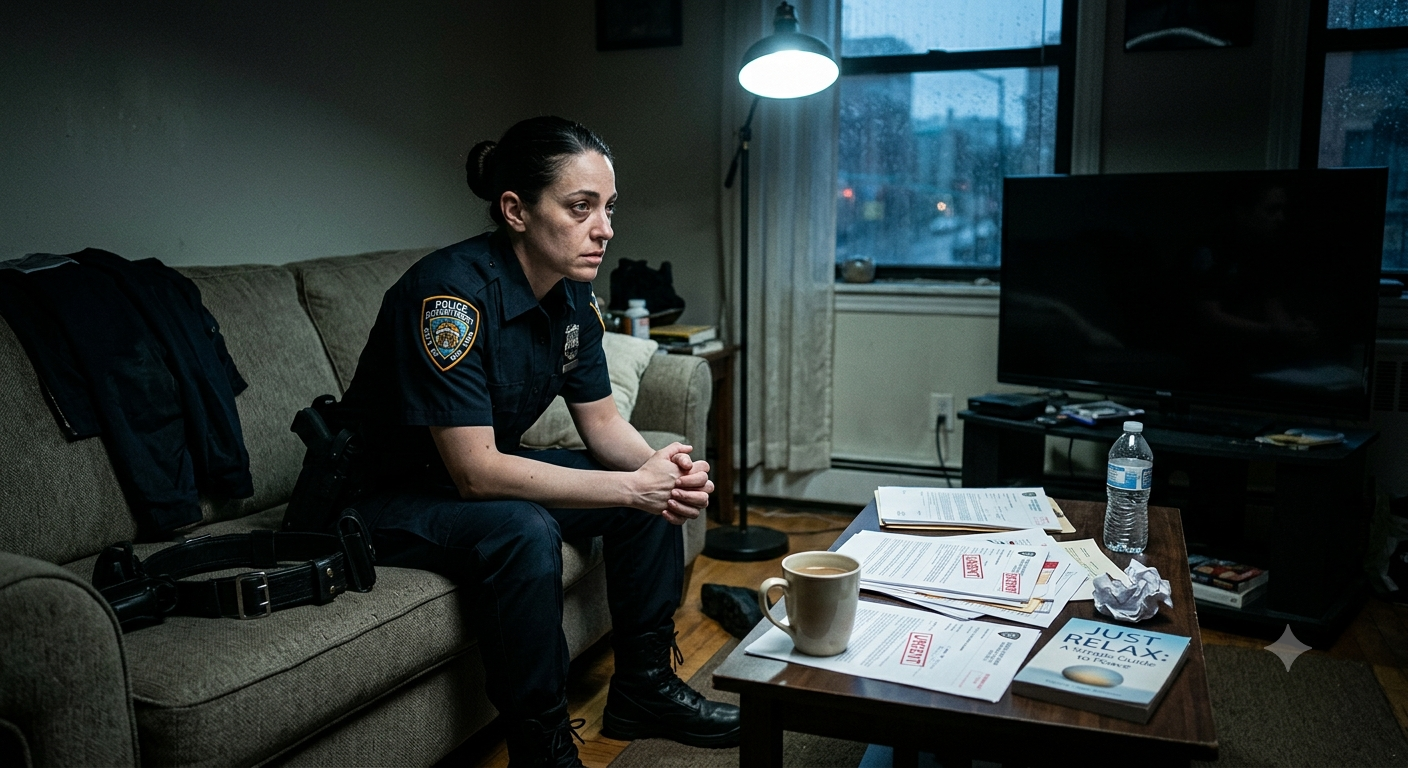
Your brain learned that staying alert kept you alive and effective, so it kept doing it. Every shift reinforced that lesson. Stay sharp. Read the room. Be ready. Your nervous system got very good at that program -- and it has no automatic off switch.
This is called conditioned vigilance.
It's the trained, survival-based alertness that persists long after the shift ends. It's a system doing exactly what it was taught to do, in a context where that training no longer serves you. Telling yourself to relax produces nothing because your nervous system responds to signals, and nobody taught it what the signal for "safe" actually looks like.
What's actually happening when you can't decompress after work -- and why does "just relax" never work?
How do you know if this is affecting you off-shift?
The real life version, not the clinical one. You scan a restaurant for exits before you sit down. You feel more at ease on a difficult shift than at a family dinner. You snap at your partner over something small and the reaction is bigger than either of you expected. Days off feel restless, irritable, like you're waiting for something to happen.
You function. You hold it together. But there's a version of you that only shows up at work, and everyone at home is getting whatever's left. If you recognize yourself in any of that, your nervous system is running the same program off the clock that it runs on it. That's conditioning -- and conditioning can be changed.
Why doesn't it just turn off when the shift ends?
Your brain doesn't experience the end of a shift as safety. It experiences it as a change of location. You drove home, changed clothes, sat down -- but none of those things sent a signal your nervous system recognized as "threat gone, stand down." So it kept running.
My partner Abe is a classically trained musician. He hears every flat note and tempo change no matter where he is -- at dinner, at a school recital, in a grocery store. Nobody questions that. We understand it's what happens when you train someone's ear at that level. Your nervous system works the same way. You were trained to read every room and assess every threat automatically. That training doesn't pause because you clocked out.
Why is this harder for women in these roles than most people realize?
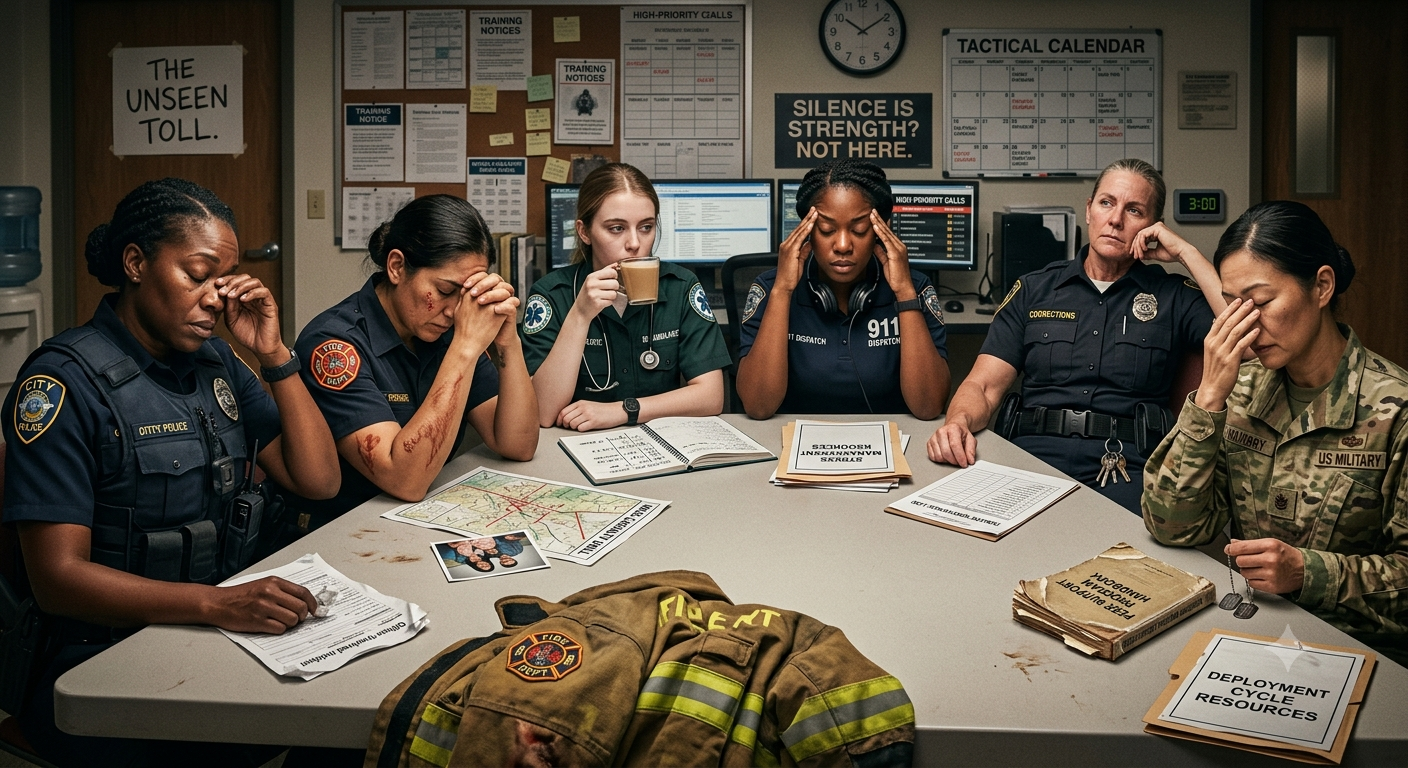
Because you're carrying a double load that rarely gets acknowledged. You're performing at the highest level on shift -- in environments that were largely built around male physiology and male communication styles -- and then going home to often be the emotional anchor for everyone there too. Your nervous system never actually gets a break.
Women in law enforcement, fire, EMS, dispatch, corrections, and the military face this specific combination: the occupational demand to stay in high-alert mode, plus the social expectation to be present and emotionally available the moment they walk through the door. Those two things are in direct conflict. And most support resources were built without that conflict in mind.
Can you retrain your nervous system without losing your edge at work?
Yes, and that's the whole point. Nervous system regulation -- teaching your body to shift between alert and calm on demand, rather than staying locked in one gear -- it sharpens performance. It doesn't soften it.
The women I work with become more effective at their jobs, because they're no longer burning through their reserve just to get through a day off. They show up to their next shift having actually recovered, instead of having white-knuckled their way through 48 hours of pretending to be fine.
The edge stays. The exhaustion goes.
What's the difference between therapy and trauma-informed coaching for this?
Therapy is clinical treatment governed by licensing boards and insurance companies. It involves diagnosis and treatment planning and goes on your medical record. It's the right tool for specific clinical needs.
Coaching is skill-building and pattern retraining for people who are functioning and want to function better. Forward-looking and practical. The Armor & Grace program is coaching -- built for the woman who wants to get ahead of this before it becomes a crisis. If something comes up that needs clinical support, I'll say so directly.
Ten years of clinical experience means I know the difference.
Concrete and specific. One of my clients took her patrol vehicle home with her. On call some nights, off call others, but her nervous system couldn't tell the difference. She was always on. We made one change: when she was off call, she parked facing the opposite direction. That single consistent physical signal started retraining her brain that the context had changed. It worked faster than either of us expected.
The tools in Armor & Grace include nervous system regulation practices and end-of-shift rituals built around your actual schedule.
You don't have to rehash what you've seen.
You just have to be willing to try something different.
What does retraining conditioned vigilance actually look like?
Where do you start if you're ready to do something about this?
Sign up for Armor & Grace directly at discoversolutions.net. The program is built for women who are ready to stop running on fumes and start actually recovering. If you have questions before you sign up, the contact page is the fastest way to reach us.
Frequently Asked Questions
Is conditioned vigilance the same as PTSD or burnout?
Conditioned vigilance can exist alongside either of those things, or completely independently of them. PTSD is a clinical diagnosis tied to specific trauma responses. Burnout is chronic exhaustion from prolonged stress. Conditioned vigilance is trained alertness that doesn't turn off -- many women experiencing it have never been diagnosed with anything and are performing well at work.
Can first responders get help without it showing up on their work record?
Coaching through Discover Solutions involves no insurance billing, no clinical diagnosis, and no records that flow to any employer or government agency.
I've tried therapy and it didn't help -- is coaching actually different?
Often yes, and there's a specific reason. Traditional talk therapy asks you to process a narrative. Nervous system and body-based work interrupts a physiological pattern. For women who've hit a wall with talk therapy, the difference in approach is usually why this works when other things didn't.
How long does it take to stop feeling on-edge all the time?
It depends on how long the pattern has been running and how consistently you practice the tools. Most women notice something shifting within the first few weeks -- a reduction in the time it takes to come down after a shift, more presence at home, less friction with the people they love.
Is it normal to feel more comfortable at work than at home?
More common than you'd think. When your nervous system has been trained to associate high-alert with competence and safety, ordinary life can feel genuinely harder to navigate than a difficult shift. There's a whole page on exactly this question in the links below.
What populations does Armor & Grace serve?
Women in law enforcement, fire, EMS, dispatch, corrections, the military, and any high-stakes role where sustained alertness is part of the job. If the work requires you to stay on, this program was built for you.
Read next:
HEAR RYANNE IN CONVERSATION

These are episodes where I've talked about conditioned vigilance, nervous system regulation, and what it actually takes to build a sustainable career in high-stakes work.
If you prefer to listen rather than read, start here.

Sirens, Slammers and Service
July 10, 2026
with Nikki Cloutier
Female first responders, conditioned vigilance, and why the nervous system doesn't clock out when you do.

Immediate Support Tools
Crisis Resources:
☑️ National Suicide Prevention Lifeline: 988
☑️ Crisis Text Line: Text HOME to 741741
☑️ First Responder Trauma Counselors: 1-877-676-6722
☑️ National Sexual Assault Hotline: 1-800-656-4673